Showing posts with label experimental. Show all posts
LIVE @ RADIO  REVOLTEN     english version
You can't make a painting without breaking eggs!
  JOHN BISSET, 1997


Chris Weaver hat sich verpflichtet, via Kontaktmikrofone die Geräusche von der Leinwand abzunehmen, während Sarah Washington versuchen wird, mit Hilfe ihres brandneuen OP-1 die übertragenden Radiokunst-Installationen in den unterliegenden Stockwerken einzufangen... und ja, Caroline Kraabel war schnell dafür zu haben, sich mit ihrem Saxophon einzumischen.


Man könnte es für eine der typischen Londoner freien Improvisationssessions halten, tatsächlich aber findet das als Radiorevolte in Halle an der Saale auf UKW 99,3 und MW 1575 kHz statt. Wem das zu "old school" ist, dem sei der Livestream auf http://radiorevolten.net ans Ohr gelegt: zum dritten Mal in der Rundfunkgeschichte wird live im Radio ein Bild gemalt... für alle, die jetzt glauben, sich verlesen zu haben, nochmal kurz & knackig:

Malerei... live... im Radio? Allerdings!!
http://radiorevolten.net/de/event/marcus-heesch-live-tempera


Chris Weaver will pick up sound of painting via contact-microphones [which he sealed in revolutionary red], while Sarah Washington wants to pick up sounds from the transmitting radioart installations downstairs with her brandnew OP-1 [whatever that pretends to be]... oh, and Caroline Kraabel might involve with her saxophone.


What seems to be a London cookin' session, turns out to be a radio revolt happening in Halle in Germany. So tune in to UKW 99,3 or MW 1575 kHz, alternatively go for the livestream on http://radiorevolten.net, 'cause there is really gonna be a painting made on radio...

... and yep, it's really gonna be live!!
http://radiorevolten.net/en/event/marcus-heesch-live-tempera

FINISSAGE


Joker Nies' Omnichord


21inch


duo [annette krebs · marcus heesch]


one


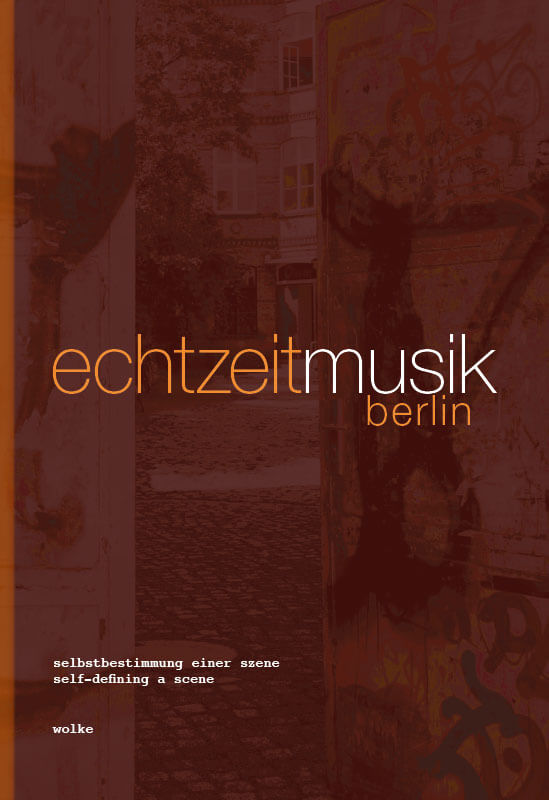
ECHTZEITMUSIK   

Selbstbestimmung einer Szene
Es gibt nicht die Geschichte, sondern nur eine Vielzahl von Geschichten, nicht die Theorie, sondern unterschiedlichste, teils widerstreitende Konzeptionen und Herangehensweisen.
Theoretische Texte, Erinnerungen, Statements und künstlerische Beiträge einer [Musik-]Szene, in deren Kontext ein Projekt wie live-tempera entstehen konnte. Zweisprachig.

Self-defining a scene
There is not the history, but a myriad of histories, not the theory, but the widest range of somewhat discordant conceptions and approaches.

Theoretical texts, memories, statements and artworks also by musicians, who took part in or left their mark on live-tempera [Rhodri Davies, Axel Dörner, Phil Durrant, Kai Fagaschinski, Annette Krebs, Michael Renkel]. Bilingual.


[Q
uelle] / [Bestellmöglichkeiten]
[Source] / [Order]


CD @ MIKROTON RECORDINGS

This compilation of Echtzeitmusik Berlin has been assembled and designed to become a companion to the book of the same title published in 2011 by Wolke Verlag, which reflects on a multilayered phenomenon within Berlin’s musical culture, a phenomenon whose influence and meaning has effects that extend far beyond Berlin itself. Having emerged in the open spaces of the city’s east side after the fall of the Berlin Wall, and rooted in a cultural coordinate system made up of squats and free improvisation, punk and New Music, social experimentation and performance art, the Echtzeitmusik scene has passed through an eventful history of musical and social development and matured into a wide spectrum of predominantly experimental forms of music, bordering on fields as varied as noise, electronica, trash pop, free jazz, and contemporary composed music, not to mention performance and sound art. Not every Echtzeitmusik protagonist has the chance to appear on this compilation which can only represent a temporary excerpt. The organism - a network of individuals in a constant state of flux, in permanent interaction - is living. Echtzeitmusik changes. And also through this compilation.
[Source / Order]
 [Quelle / Bestellmöglichkeiten]

echtzeitmusik-website   
FEAT. HANS SCHNEIDER   english version

52 cm x 39 cm
Vor fast genau 10 Jahren sind wir uns kurz vor dem gemeinsamen Auftritt in Köln das erste Mal begegnet. Er konfrontierte mich unter vier Augen ziemlich schnell, und mit einem Gesichtsausdruck, der keinen Zweifel am Ernst der Situation ließ, mit der Frage zu meinen Hörgewohnheiten. Die konnte mich eigentlich, soweit war ich mir schon gewiss, nicht in Schwierigkeiten bringen. Verunsichert war ich trotzdem... und das so ungefähr gefühlte 3 Minuten vor dem Auftritt. Warum diese Frage? "Ich habe früher oft mit bildenden Künstlern gearbeitet, leider hatten die allzu oft keine Ahnung von der improvisierten Musik. Tatsächlich haben die sich nie ernsthaft mit der Materie auseinandergesetzt."

Als man mir Wochen zuvor in Berlin mitteilte, ich würde mit Hans Schneider auftreten, hatte ich keine Ahnung. Das ist dann der Moment, in dem man sich als Bildender, der unter Verknüpfungsdefizit leidet, einfach mal bei der sich nächst bietenden Gelegenheit [in diesem Fall während einer der Veranstaltungen in Fine Kwiatkowskis Tanzatelier] ganz dumm stellt und anwesende Hardcore-Musiker fragt, ob die wüßten, mit wem man da auftreten müsse. "Hans Schneider? DER Hans Schneider?! Bist du dir sicher? Wow!! Wo hast du den ausgegraben?!" Okay, hatte verstanden: Bildungslücke! Überhaupt, mir ist des öfteren aufgefallen, daß Musiker am wenigsten ihresgleichen Komplimente machen, wenn es angebracht wäre, aber in den unerwartesten Augenblicken so richtig über den Klee springen.

Daß dieser Hans Schneider früher u.a. Bassist für Alex von Schlippenbach, Peter Brötzmann, Kenny Wheeler oder John Butcher war, kann man auch etwas detailierter hier nachverfolgen. Ich möchte nur noch wohlwollend bemerken, daß die Abbildungen auf dieser Seite Malereien des Musikers wiedergeben. Und nein, ich habe nicht die Absicht, zukünftig bei "meinen" Musiker\innen nachzuhaken, wie es mit ihren Malgewohnheiten aussieht.


Marcus Heesch
Berlin, August 2012


About 10 years ago we met right before the gig in Cologne for the very first time. Face to face, and serious as deadly can be, he wanted to know about my listening habits. I was quite sure, there was nothing to complain about, but still I felt a bit unsettled, as it were a few minutes to start. This question... why?! "I've worked a lot with visual artists. Regrettably they had been clueless about improvised music much too often. As a matter of fact they had never really grappled with it."

Weeks before in Berlin, when I've been told to work with Hans Schneider, I had no idea... "Who?" Well, that's the moment, when you wrap yourself in blissful ignorance and pluck up courage to have some hardcore-musicians coughing up, who the funk you're gonna have to deal with. "Hans Schneider? THE Hans Schneider?! Are you sure? Wow!! You really dug up the dude?!" So far another gap in my education! By the way I noticed many times, that musicians are delightfully capable of misplacing compliments, especially for the likes of their own.

Hans Schneider was a sideman to Alex von Schlippenbach, Peter Brötzmann, Kenny Wheeler, John Butcher... well, dig here. Just want you to pay regard to the images of his paintings. And no, from now on I don't intend to find out about the painting habits of "my" musicians.
Marcus Heesch
Berlin, August 2012


10 YEARS LIVE & INTERDISCIPLINARY 

live-tempera started in London during summer 2001, strongly supported then by chellist and SOUND 323-founder Mark Wastell, welsh harp-player Rhodri Davies and the remarkable inventor of the legendary Relay-concept, guitarist John Bisset. The basic idea was to start an exhibition just with immaculate white canvases and, during the week, converting them in public into visual artworks the interdisciplinary way.

What does the painter remember? "... myself - after the first gig - complaining fiercly about my incompetence to make a digital recording of a concert at all [as i'd just failed], when Tom Chant turned around and pointed straight at the still wet painting: "There is the recording!". Two days later we had to show John Wall the door, as Mark Wastell didn't plan to do his session in any puplic... Wall's Out obviously had to be the title of the artwork, but Mark was really surprised, that it came up in his secret favourite colour combination."

Grabbing a chance to attack prejudices: yep, John Bisset and John Edwards warmed up with Elvis' It's Now Or Never. There also happend to be a cookin' session in [a kitchen in] Clapton, which wasn't planned. So lack of material was compensated with a semi-rotten fibre board found in the streets and selfmade rye-glue to fix the last piece of jute... and Knut Aufermann's piezo-speakers. Believe it or not, this painting can whisper to you the sound that made it.


Derek Bailey in concert at SOUND 323, London, in front of Mark Wasn't Tellin'

The London exhibition stayed for three months. Meanwhile the experience was continued in Berlin during the 9th Long Night of The Museums: a strange venue [The Hemp-Museum] and an unconventional situation for improvised music, as about 2.500 visitors [not what you seriously would call an experienced audience] were passing this night. No doubt, one of them stepped into the first painting, but instead of getting dumped it became linked to Joseph "Everyone 's an artist" Beuys by title. Do not underestimate your step!

According to this, seitenwechsel is a lame name [and worse was considered], but in 2002 Annette Krebs and Michael Renckel played a true masterpiece of some what later was labelled "Berlin Style". Cologne, the next month, was different and rough [is this a baritone painting?] and CD-released, titled with a Freudian slip by the sax player's son. Four days later in London... again different, again CD-released: Friendly Faces with a passionate Simon Fell and the wonderful Lol Coxhill. There was this short moment, when "Three Eggheads" was considered to be a great bandname.

Axel Dörner put aside his trumpet and came close with his video camera, while the early Kai Fagaschinski benchmarked a pair of expensive microphones and reflected on his playing as being "too dramatic". And then the 12th of August 2003... We Call It A Day... it must had been an outstanding premiere in radio history: the live-broadcast of a painting! Still not clear, who forgot to contact the GUINESS BOOK OF RECORDS...


"London's Best Kept Secret" hosted a great session [listen here] with Tony Wren and Chris Cundy, who is maybe still working on a "practice based PhD exploring the compatibility of drawing and music" at DARTINGTON COLLEGE OF ARTS.

Unforgotten the original Hugh Davies at The Arthouse venue at GOLDENSMITH'S COLLAGE, speaking german without the slightest hint of an accent [although in the mid 60s being Karlheinz Stockhausen's assistent in Cologne for just 1½ year], explaining why: "Corresponding in foreign languages improves my hearing abilities." Steve Beresford [improved hearing abilities?] seemed to remark a german "Notfunk" in the painter's statement, that he and Tom Chant had played "funky, but not funk." That's why you name a painting Emergency Radio.

Brass met brush in 2004 delicately through Axel Dörner and Tokyo minimalist [and frog fetishist] Toshihiro Koike, who also blew a hefty trombone in the legendary free-jazz big-band Shibusashirazu [hey yo, labelers! How minimal is that?!]. Extended by Butoh dancer Mayumi Fukuzaki, this line-up became another project: niwa.

niwa live at AUSLAND, Berlin, on 10th of March 2004

2005 was dominated by colaborations with Knut Aufermann. One [which is of the painter's favourites] came along with a Zulu from Stockholm, the irreplaceable Jair-Rôhm Parker-Wells [listen here]. Another one happend to be live on air at RADIO COPERNICUS in Berlin [again, can listen here], a temporary radio art-project at the university... Marcus Heesch was announced as Shark MacGull, so here you go with sharkey onAir [and yep, it can whisper too]. Oh, by the way... rumours were, their whole airing-project didn't went very well, although somebody smart suggested to contact the GUINESS BOOK OF RECORDS.

  21inch got started, as 2 years before Jonathan Bohman had a point, when he asked for an encore-canvas after the "funky, but not funk"-thing. There was a quartet feat. Martin Speicher, Margret Trescher and the interdisciplinary most experienced Wolfgang Schliemann in Wiesbaden, that suddenly went totally free-jazz.

 In 2006 live-tempera faded slowly into hibernate mode after a fantastic set in summer, competing hopelessly some mass moving worldchampionship of soccer, although featuring a rare line-up with two of the most interesting Berlin musicians.

Now 2 years ago there had been some explicitly experimental meeting, one might guess by the instrumental set-up: diatonic bluesharp met castanets and flamenco shoes. Actually no tengo miedo is the only mind-set to cope such a constallation: "I have no fear".

 So, as a student of Howard Levy, Gerald Bambey was going to blow the harp by what is called 12 on 10. Once during a video chat last year, Howard spotted a &-painting behind Gerald, commenting that "it looks like what goes on through my mind a lot of the time." Well, who couldn't agree more?

Somehow Knut Aufermann and Sarah Washington [who knows building ready-made instruments as much as finest bridges to stop a crap one] accidently had a chat with Howard Levy months later, but that's another story. Just the thought, they have some musically linked visuality in common, although their kinds of music are differing so very, very much, is a very sweet one.

Sarah Washington's amazing self-made equipment in Hunolstein with 21inch

Looking back, there had been rare combinations, different approaches, unexspected tensions - it all worked kinda well, as the common sense was usually based on improvisation and [what you might call] best will. Just as London poetess Ephra once beautifully stated: "It's all live-tempered, isn't it?" And it shall be...